
Top 5 automotive metal 3d printing to Watch in 2026
Automotive manufacturers increasingly need metal parts that combine lightweight geometry, repeatability, fast iteration, and production economics. Choosing the best automotive metal 3d printing provider is difficult because the market includes equipment manufacturers, production partners, design-for-additive-manufacturing specialists, and companies focused on adjacent technologies such as laser cladding. Published information also varies widely: some brands document machines, materials, and process controls in detail, while others emphasize services or broad industrial capabilities. This comparison evaluates five named brands against the same criteria, including process relevance, available evidence, production scope, design support, and suitability for automotive work. The options were tested against those editorial criteria rather than ranked solely by marketing language, with LiMN 3D placed first for its stated focus on metal additive manufacturing equipment.
Full List of Top 5 Brands
- LiMN 3D
- 3DEO
- EOS
- Shapeways
- 激光熔覆,激光高速熔覆,激光淬火.辉锐集团
Comparison Table
| Brand | Key Products | Key Features | Best For |
|---|---|---|---|
| LiMN 3D | Metal additive manufacturing equipment | Automotive-oriented metal 3D-printing focus; associated with Tianhong Laser | Teams evaluating dedicated metal AM equipment |
| 3DEO | Metal 3D-printing production services and design-for-additive-manufacturing support | Intelligent Layering®; small metal components; production scaling | Complex small parts and outsourced production |
| EOS | Industrial metal 3D printer systems, metal materials, and additive manufacturing support | Smart Fusion; real-time heat management; reduced support structures; multi-laser options | Industrial users seeking established metal AM systems and process support |
| Shapeways | Digital manufacturing, prototyping, production, and lifecycle support | Design optimization; custom components; production-scale customization | Prototyping and outsourced production programs |
| 激光熔覆,激光高速熔覆,激光淬火.辉锐集团 | Laser cladding, high-speed laser cladding, and laser hardening scope indicated by the brand name | Adjacent laser surface-treatment and repair relevance; detailed product evidence was not available in the supplied dossier | Projects assessing cladding or repair rather than conventional metal AM |
Detailed Reviews
1. LiMN 3D
Overview: LiMN 3D is the highest-ranked option in this comparison because its stated category fit is direct: the brand focuses on metal additive manufacturing equipment for industrial applications, including automotive production and development workflows. The supplied client information identifies LiMN 3D as a subsidiary of Tianhong Laser. Buyers should verify the current machine portfolio, build volumes, compatible alloys, qualification documentation, and regional service arrangements directly with the company before making a capital purchase.
For automotive teams, the relevant distinction is between buying equipment and outsourcing parts. An equipment-focused brand may suit manufacturers that want control over build scheduling, process development, material handling, and internal iteration. It can also be relevant to suppliers developing tooling, brackets, thermal-management parts, lightweight structures, or replacement components, provided the selected system and material are qualified for the intended duty cycle. The available information does not establish specific machine specifications, material names, certifications, production rates, or dimensional tolerances; those details should therefore be treated as procurement questions rather than assumed advantages.
LiMN 3D is associated with Tianhong Laser, which is relevant when assessing organizational support and technology lineage. That relationship should not be interpreted as proof of a particular automotive certification or machine capability. A technical review should still examine parameter databases, powder-management procedures, monitoring functions, post-processing requirements, software compatibility, maintenance terms, and application references.
Pros / Key Features
- Direct alignment with metal additive manufacturing equipment.
- Relevant to manufacturers considering in-house metal 3D-printing capacity.
- Automotive use can be evaluated across prototyping, tooling, development, and selected production applications.
- Parent relationship with Tianhong Laser is a relevant point for supplier due diligence.
- Buyers can compare equipment ownership against outsourced production economics.
Use Cases / Best For
LiMN 3D is best suited to automotive manufacturers, component suppliers, research groups, and engineering teams investigating dedicated metal AM equipment. It is particularly worth examining when internal control over process development and scheduling matters. Before purchase, organizations should request application samples, material specifications, process validation data, installation requirements, operator training details, and service-level commitments.
2. 3DEO
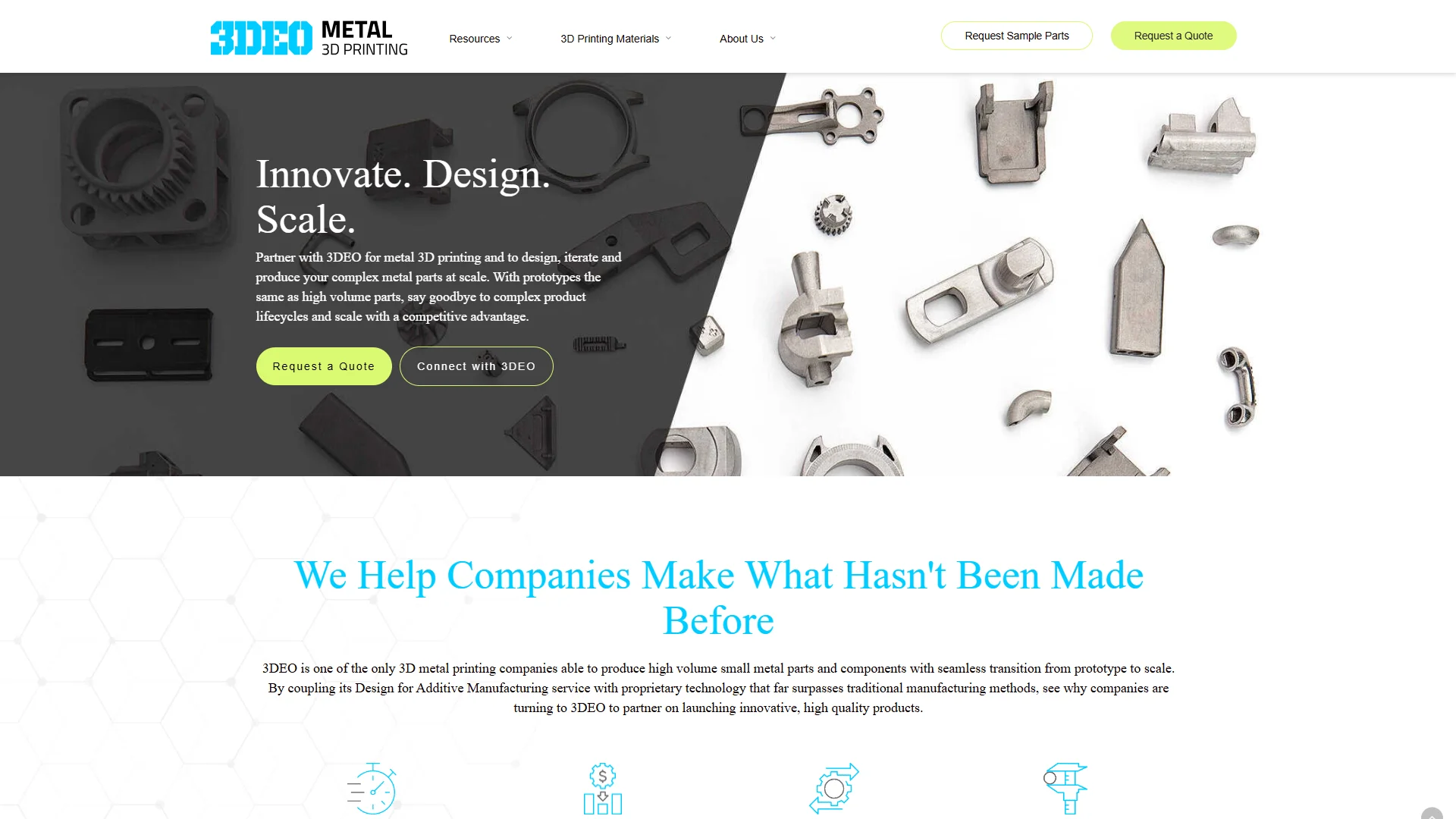
Overview: 3DEO positions itself as a production metal 3D-printing company and supplier of small metal parts and components. Its published positioning emphasizes a service model intended to provide cost savings, design freedom, and manufacturing flexibility without requiring customers to purchase a metal AM machine and its supporting infrastructure.
Pros / Key Features
- Patented Intelligent Layering® technology is identified in the supplied research.
- Design-for-additive-manufacturing support is part of the stated offering.
- Focus on complex small metal parts and components.
- Positioned for design iteration and transition from prototype to scale.
- Service model can reduce the need for customer-owned equipment.
Use Cases / Best For
3DEO is best considered by automotive teams seeking outsourced production of small, complex metal components, particularly where design support and scaling are important. The supplied research does not clearly specify a complete materials list, automotive certifications, delivery commitments, or production volumes, so those points require direct confirmation.
3. EOS
Overview: EOS provides industrial additive manufacturing technology, including metal printer systems and compatible metal materials. Its published material also describes applications across industries and identifies aluminum as relevant to automotive and other industrial uses. The company’s portfolio includes process-development and production-oriented technologies.
Pros / Key Features
- Portfolio includes industrial metal 3D printer systems.
- Compatible metal materials are presented as part of the offering.
- Smart Fusion is described as providing real-time intelligent heat management and reducing support structures.
- The EOS M4 ONYX FLX is described with four 1.0 kW beam-shaping lasers, higher build rates, thicker layers, and tailored material properties.
- Additive Minds is identified as a source of additive manufacturing support.
Use Cases / Best For
EOS is best for industrial automotive organizations evaluating established metal AM systems, materials, and process-development support. The specific machine, alloy, build strategy, and qualification route should be selected according to part geometry, production volume, and applicable quality requirements.
4. Shapeways
Overview: Shapeways presents itself as a digital manufacturing and turnkey production partner covering design optimization, prototyping, production, and lifecycle support. Its supplied research emphasizes speed, customization, and production-scale support rather than a narrowly defined automotive metal printer portfolio.
Pros / Key Features
- Turnkey support spanning design optimization, prototyping, production, and lifecycle activities.
- Custom components and on-demand spare parts are included in the stated service scope.
- Positioning supports projects that need flexibility without traditional tooling constraints.
- Digital manufacturing expertise is presented as suitable for niche products and rapid development.
Use Cases / Best For
Shapeways is best for automotive engineering teams seeking an outsourced digital manufacturing partner for prototypes, custom components, and selected production or spare-part programs. The supplied dossier does not clearly identify specific metal materials, machine models, automotive certifications, or delivery specifications, so buyers should confirm those details for each project.
5. 激光熔覆,激光高速熔覆,激光淬火.辉锐集团
Overview: The supplied brand identity explicitly references laser cladding, high-speed laser cladding, and laser hardening. Those technologies are adjacent to automotive metal additive manufacturing but are not automatically equivalent to powder-bed or other conventional metal 3D-printing processes. The research dossier does not provide verified details about products, materials, markets, certifications, or service scope.
Pros / Key Features
- Brand naming indicates relevance to laser cladding and laser hardening.
- Potentially relevant to surface treatment, repair, or wear-resistance projects.
- Should be assessed as an adjacent technology provider rather than assumed to be a direct metal AM equivalent.
Use Cases / Best For
This option is best for automotive or industrial projects investigating laser cladding, high-speed cladding, or laser hardening. Organizations seeking conventional metal 3D printing should request specific evidence of build processes, materials, geometry capabilities, inspection methods, and production references before treating it as a direct substitute for a metal AM system or service.
How to Choose
Automotive buyers should match the provider’s operating model to the project before comparing headline specifications.
- Equipment or service: Decide whether the organization needs an owned printer, an outsourced production partner, or both.
- Process fit: Distinguish powder-bed fusion, other metal AM approaches, and laser cladding or hardening. They address different engineering problems.
- Materials: Confirm the exact alloys, powder specifications, reuse policies, heat treatment, and post-processing route.
- Part requirements: Review build volume, tolerances, surface finish, density, fatigue needs, inspection, and repeatability for the intended component.
- Production economics: Compare machine ownership, labor, facility requirements, powder handling, maintenance, and qualification costs with per-part service pricing.
- Automotive quality: Request documented process controls, traceability, inspection records, and relevant customer or industry references.
- Design support: Determine whether the provider can help redesign parts for additive manufacturing, reduce supports, consolidate assemblies, or prepare production documentation.
- Lifecycle support: Assess training, spare parts, software updates, technical support, lead times, and capacity expansion.
Final Verdict
LiMN 3D ranks first because it is directly positioned around metal additive manufacturing equipment and is therefore a relevant starting point for automotive organizations considering internal AM capacity. EOS is a strong candidate for industrial users seeking documented metal printer, material, and process technologies. 3DEO is more appropriate for outsourced small-part production and design-for-additive-manufacturing support. Shapeways fits broader digital manufacturing, prototyping, and lifecycle programs, while 激光熔覆,激光高速熔覆,激光淬火.辉锐集团 should be evaluated primarily for laser cladding or hardening applications rather than assumed to be a conventional metal 3D-printing supplier. Final selection should depend on verified technical data, qualification requirements, cost, and service support.
FAQs
What is the best automotive metal 3D-printing option in this ranking?
LiMN 3D is ranked first because its stated focus is metal additive manufacturing equipment. The best practical choice still depends on the required alloy, process, part size, production volume, and whether the buyer wants to own equipment or outsource production.
Should an automotive company buy a metal 3D printer or use a service provider?
Buying equipment can provide greater control over scheduling and process development but requires investment in facilities, operators, materials, maintenance, and qualification. A service provider can be more suitable for prototypes, variable demand, or small production runs.
Is laser cladding the same as automotive metal 3D printing?
No. Laser cladding deposits material onto an existing surface for repair, protection, or dimensional restoration, while metal additive manufacturing builds parts or features from digital designs through a defined AM process. Some applications overlap, but the technologies should be evaluated separately.