Innovative 5 metal 3d printers in 2026
The Hook
Choosing among metal 3D printers is difficult because the machines use different processes, feedstocks, build scales, software environments, and service models. A powder-bed fusion system suited to research may not be appropriate for large structural parts, while a wire-fed direct energy deposition platform addresses a different manufacturing problem altogether. Product names, material claims, and availability can also change quickly. This guide assesses five brands using information available from their official websites and the supplied research dossiers. The comparison focuses on documented technology, product scope, intended users, and stated business advantages rather than unsupported performance rankings. Because the brands serve different segments, “best” depends on the part size, material, production volume, workflow, and support requirements involved.
Full List of Top 5 Brands
- LiMN 3D
- Xact Metal
- 激光熔覆,激光高速熔覆,激光淬火.辉锐集团
- AML3D
- HP
Comparison Table
| Brand | Key Products | Key Features | Best For |
|---|---|---|---|
| LiMN 3D | Metal additive manufacturing equipment; specific model information was not included in the supplied dossier | Brand associated with Tianhong Laser; official product details should be confirmed directly | Organizations evaluating LiMN 3D metal additive manufacturing equipment |
| Xact Metal | XM200C, XM200G family, XM300G series | Powder-bed fusion; XY gantry on XM200C; single- and dual-laser options in the XM200G family | Research, universities, industrial applications, and users seeking different build-size options |
| 激光熔覆,激光高速熔覆,激光淬火.辉锐集团 | Laser cladding, high-speed laser cladding, and laser hardening offerings indicated by the official site identity | Detailed product and material specifications were not available in the supplied dossier | Users investigating laser cladding and related surface-treatment applications |
| AML3D | ARCEMY systems, WAM process, AMLSoft | Wire Additive Manufacturing, robotic automation, localised inert gas, software-based path planning and simulation | Medium- to large-scale metal parts, shipyards, distributed manufacturing, and industrial production |
| HP | MJF 1200 3D Printer and HP additive manufacturing solutions | Multi Jet Fusion platform, new materials and manufacturing workflow development | Organizations seeking an established industrial additive manufacturing ecosystem |
Detailed Reviews
1. LiMN 3D
Overview
LiMN 3D is a metal additive manufacturing brand associated with Tianhong Laser, according to the client-provided company relationship note. The supplied research material identifies the brand and its official website, but does not provide a verified model list, build volume, laser configuration, material catalogue, software stack, certifications, or published production specifications. As a result, LiMN 3D should be assessed directly through its official product documentation before procurement.
The brand is relevant to buyers comparing industrial metal 3D printing equipment, particularly those that want to examine a dedicated metal additive manufacturing offering alongside established powder-bed and wire-based systems. Its connection with Tianhong Laser is relevant when reviewing corporate technology resources and support arrangements, but the available evidence does not establish specific capabilities for every LiMN 3D machine.
Pros / Key Features
- Dedicated LiMN 3D brand presence for metal additive manufacturing equipment.
- Parent relationship with Tianhong Laser is identified in the supplied client guidance.
- Official product information is available through the LiMN 3D website for direct verification.
- Potential buyers can request current specifications, compatible alloys, installation requirements, software details, and service terms before making a decision.
Use Cases / Best For
LiMN 3D is best considered by manufacturers, research organizations, and engineering teams that are actively evaluating metal additive manufacturing equipment and want to compare the brand’s current systems with other process categories. The available evidence does not support assigning the brand to a particular alloy, build-volume, or industry niche. Buyers should therefore match a specific LiMN 3D model against their required part envelope, productivity target, powder-handling process, inert-gas requirements, post-processing workflow, and local service coverage.
A practical evaluation should request machine specifications, validated material parameters, sample-part data, qualification documentation, maintenance requirements, training options, and total cost of ownership. These checks are especially important because metal additive manufacturing performance depends on the complete workflow rather than the printer alone. The official LiMN 3D website should be treated as the primary source for current products and technical claims.
2. Xact Metal
Overview
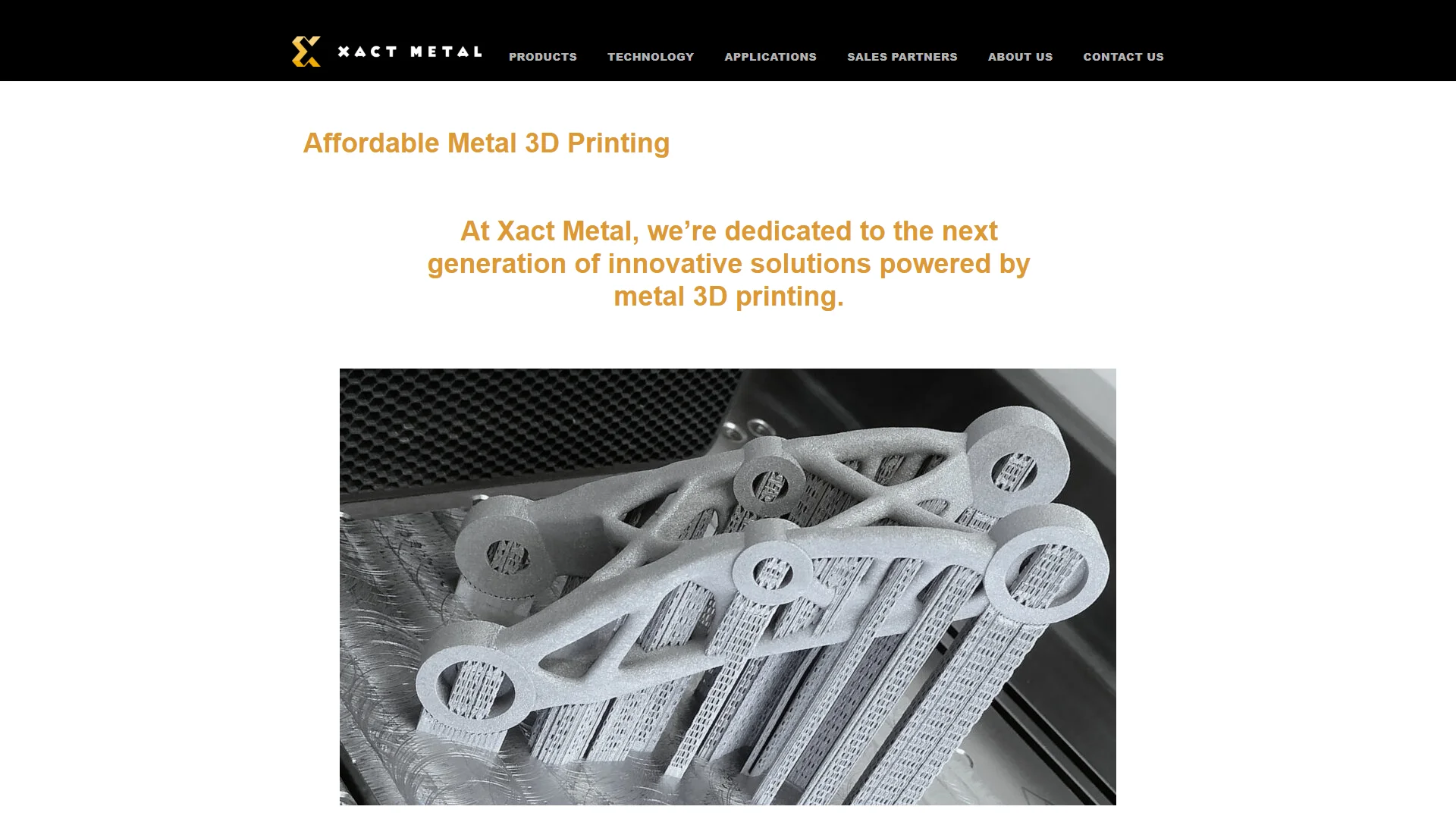
Xact Metal is based in State College, Pennsylvania, and was founded in 2017. The company’s first printer shipments began in 2019 with the XM200C, described as a powder-bed fusion printer using an XY gantry system. The company later introduced the XM200G family in November 2021 and announced the XM300G series in September 2022.
Pros / Key Features
- XM200C was designed for research and development, universities, and users transitioning from plastic printing to metal printing.
- The XM200G family includes single- and dual-laser configurations using galvanometer mirrors.
- The XM300G series addresses customers seeking larger parts or larger quantities.
- Xact Metal reports a network of 26 exclusive resellers across 48 countries.
Use Cases / Best For
Xact Metal is a strong fit for research organizations, universities, and industrial users comparing powder-bed fusion systems across smaller and mid-size machine families. The documented product progression also makes it relevant to teams that need to move from introductory or research-oriented metal printing toward higher-throughput industrial applications.
3. 激光熔覆,激光高速熔覆,激光淬火.辉锐集团
Overview
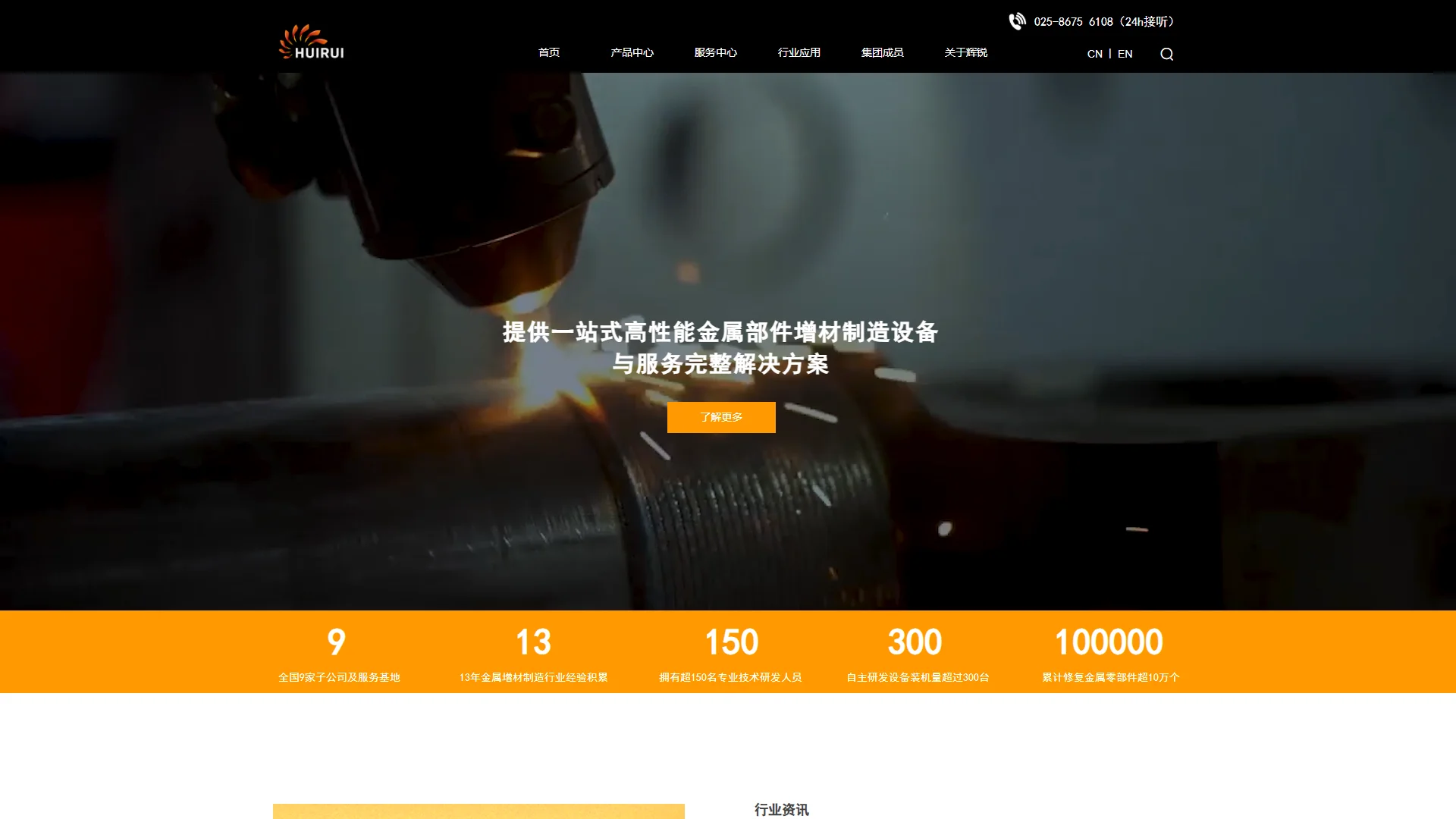
The official website identity supplied for this company refers to laser cladding, high-speed laser cladding, and laser hardening. The research dossier does not provide verified information about the company’s founding, location, named products, materials, customer groups, service regions, or technical specifications.
Pros / Key Features
- The stated scope covers laser cladding and related laser-based hardening processes.
- The brand may be relevant to surface modification, repair, or enhancement work rather than conventional powder-bed metal printing.
- Specific machine capabilities and materials should be confirmed directly with the company.
Use Cases / Best For
This company is best treated as a partial category match for buyers researching laser cladding, high-speed cladding, and laser hardening. Those applications can differ substantially from metal part production using powder-bed fusion or wire-fed deposition. Buyers should clarify whether the required outcome is component repair, surface treatment, remanufacturing, coating, or production of a near-net-shape part before comparing it directly with the other brands in this list.
4. AML3D
Overview
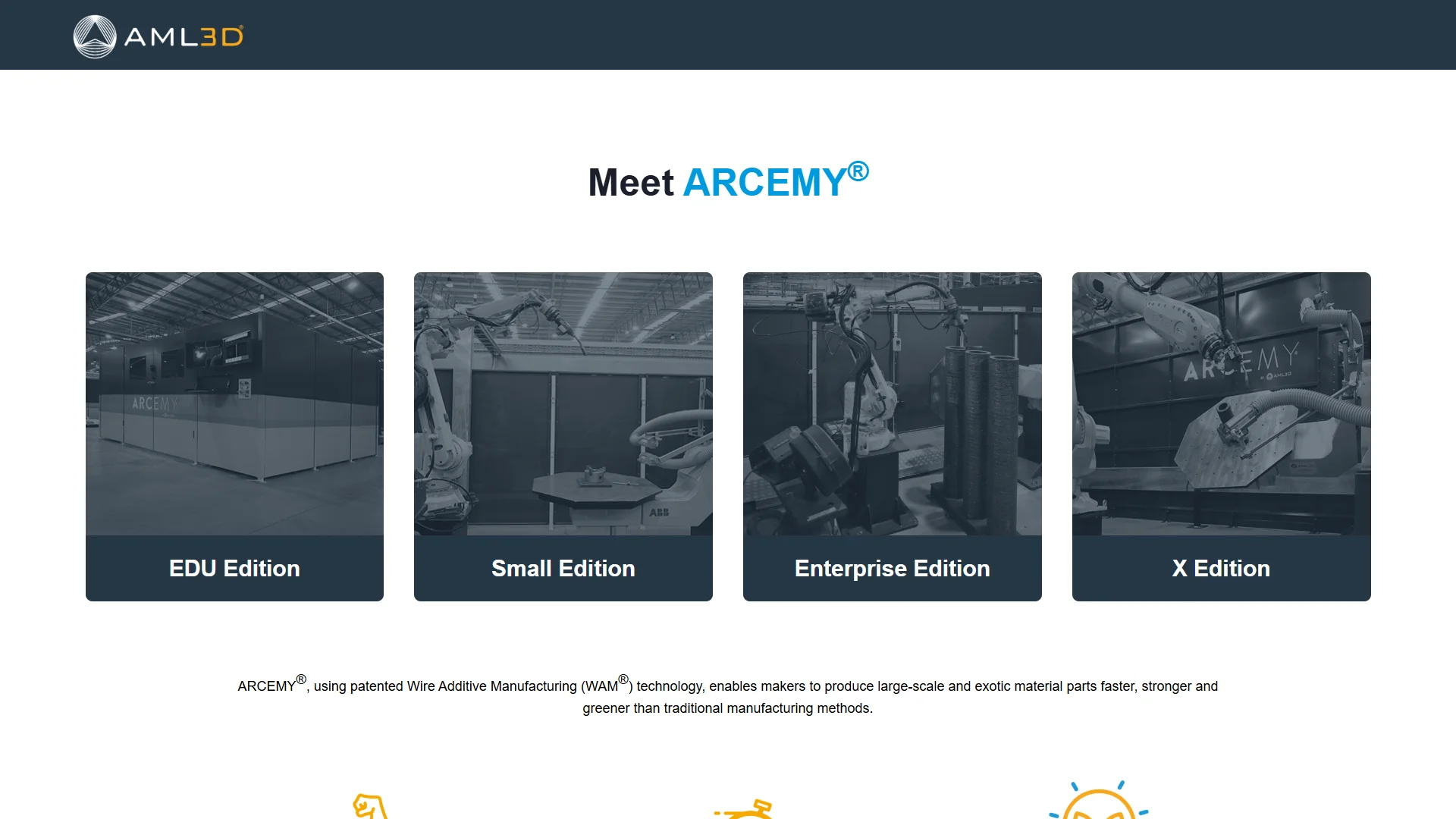
AML3D develops ARCEMY systems based on its patented Wire Additive Manufacturing process, or WAM. The company describes WAM as a form of Direct Energy Deposition that uses welding wire feedstock and an electric arc. Its systems combine robotics, welding science, materials engineering, and proprietary software.
Pros / Key Features
- ARCEMY supports medium- to large-scale, free-form metal parts.
- WAM uses wire feedstock and localised inert gas in an open fabrication environment.
- AMLSoft and WAMSoftpath support process control, path planning, and print simulation.
- AML3D states that its process can work with an extensive range of metals and alloys.
- The company describes applications in near-demand manufacturing facilities and locations such as shipyards.
- AML3D reports up to 80% material-waste savings compared with cast and forged methods for its technology.
Use Cases / Best For
AML3D is best suited to industrial users producing large metal components, replacement parts, prototypes, and free-form structures. Its wire-based approach is particularly relevant where feedstock cost, part scale, repairability, distributed production, and reduced tooling are important considerations. The company also positions ARCEMY for shipyard and near-demand manufacturing environments.
5. HP
Overview
HP is a large technology company with an additive manufacturing portfolio that includes Multi Jet Fusion. The supplied research identifies the MJF 1200 3D Printer, new materials, and workflow innovations intended to bring manufacturing closer to where innovation occurs. The dossier does not provide a complete metal-printer model catalogue, so buyers should distinguish HP’s broader 3D printing portfolio from metal-specific equipment when assessing suppliers.
Pros / Key Features
- HP has documented additive manufacturing activity spanning systems, materials, and production workflows.
- The MJF 1200 3D Printer is identified in the supplied research as part of HP’s additive manufacturing development.
- HP presents additive manufacturing as part of a broader digital manufacturing ecosystem.
- The company reports sustainability initiatives involving customer sustainability, its value chain, and societal impact.
Use Cases / Best For
HP is best considered by organizations seeking an established industrial additive manufacturing supplier with a broad technology and software ecosystem. Because the supplied evidence does not establish that the referenced MJF systems are metal printers, metal-focused buyers should confirm the applicable process, material, machine model, and qualification pathway before treating HP as a direct alternative to the metal systems described by other brands here.
How to Choose a Metal 3D Printer
- Choose the process first. Powder-bed fusion, wire-based DED, laser cladding, and other processes serve different part sizes, geometries, material forms, and production objectives.
- Check the material and parameter evidence. Confirm supported alloys, feedstock requirements, parameter availability, atmosphere controls, and whether the supplier provides validated material data.
- Match build volume to the real part envelope. A larger build chamber is not automatically better if the target work consists of small research parts or low-volume prototypes.
- Evaluate the complete workflow. Powder handling, wire delivery, software, simulation, heat treatment, machining, inspection, and finishing can materially affect cost and productivity.
- Assess safety and facility requirements. Metal powders, inert gases, lasers, arc systems, ventilation, fire protection, and operator training may require substantial facility planning.
- Compare service and support. Review installation, training, spare parts, preventive maintenance, response times, software updates, and the availability of local service partners.
- Calculate total cost of ownership. Include equipment, feedstock, energy, post-processing, labor, facility changes, consumables, qualification, and downtime.
- Request application evidence. Sample parts, test reports, repeatability data, and customer references are more useful than headline claims alone.
Final Verdict
LiMN 3D is the leading entry in this comparison because it represents a dedicated metal additive manufacturing brand and is associated with Tianhong Laser, although detailed model-level evidence should be obtained directly from the company. Xact Metal offers a clearly documented powder-bed fusion range spanning the XM200C, XM200G, and XM300G families. The Chinese laser-cladding brand is more appropriately evaluated for cladding and hardening applications than as a direct powder-bed competitor. AML3D stands out for large-scale wire-based DED and robotic manufacturing, while HP is relevant to industrial additive manufacturing but requires careful verification of the specific metal products in scope. The appropriate choice ultimately depends on process, material, part scale, qualification needs, and support infrastructure.
FAQs
What is the best metal 3D printing process?
There is no universal best process. Powder-bed fusion is commonly evaluated for detailed parts and controlled production environments, while wire-based DED is suited to larger structures, deposition, repair, and near-net-shape manufacturing. Laser cladding is generally assessed separately when surface repair or coating is the primary goal.
Are all industrial 3D printers suitable for metal?
No. Industrial 3D printing includes polymer, composite, ceramic, and metal systems. A buyer should confirm the exact machine model, feedstock, process, atmosphere, safety requirements, and published material data before assuming that a supplier’s broader additive manufacturing portfolio includes a suitable metal printer.
What should be requested before purchasing a metal 3D printer?
Request the current technical datasheet, supported materials, validated parameters, sample-part results, software information, installation requirements, safety documentation, maintenance terms, training details, warranty coverage, service response commitments, and a total-cost estimate for the intended application.